

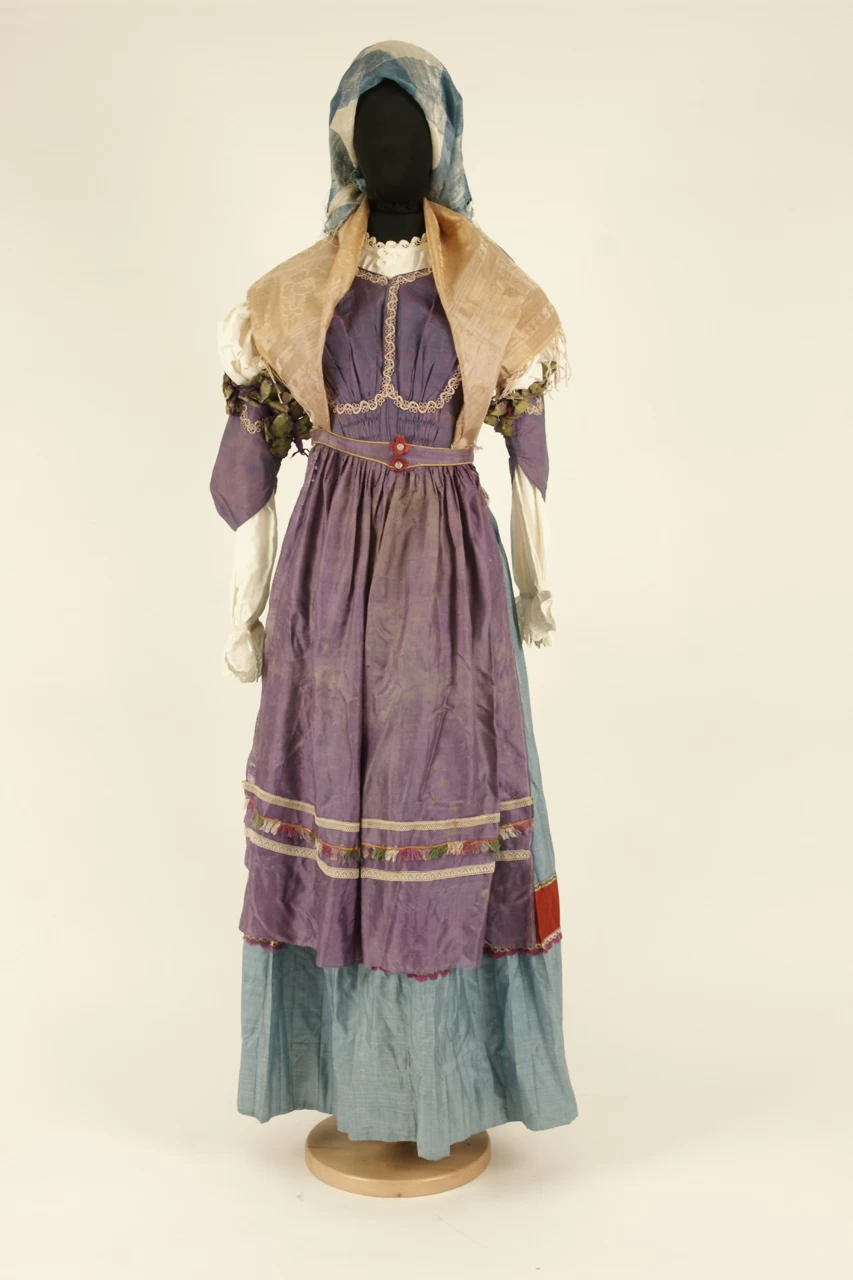
The Traditional Costume of Campodipietra
The traditional costume represents a fundamental part of the cultural heritage of many Italian regions, and Campodipietra, a small town in Molise, is no exception.
The Campodipietra costume, like many other traditional outfits, is the result of a long historical and cultural evolution, closely linked to daily life and local celebrations. Through the study of historical, iconographic, and material sources, we can now reconstruct the appearance, meaning, and importance of this garment in the community of Campodipietra.
Here we tell the story of the traditional women’s costume of Campodipietra, exploring its evolution over time and revealing the most fascinating details that make it unique.
The Historical and Social Context of the Costume
The traditional costume of Campodipietra, as in many other areas of Molise, was primarily worn by the lower social classes, that is, by women of the “lower class.”
Despite its modest origin, this outfit had a strong symbolic and communicative value, which went far beyond the simple practical function of clothing. Every detail of the costume could tell a lot about the person wearing it: age, marital status, and economic condition were often clearly readable through the use of certain colors, ornaments, and accessories.
The Campodipietra costume also reflected the influence of the Spanish aristocratic fashion of the 1500s. During the Spanish domination of the Kingdom of Naples, local populations began to imitate, with more modest materials, the fashions of the aristocracy. These influences manifested mainly in festive clothing, which, while distinct from the wealthier classes, were enriched with decorative details of value, such as gold and silver braids.
The Historical Sources
To reconstruct the traditional costume of Campodipietra, researchers have relied on various sources, including notarial acts, period photographs, and a rare example of a bridal female costume kept at the Museum of Arts and Popular Traditions in Rome.
One of the most valuable sources is a photograph dating back to the early 1900s, taken by Campobasso photographer Alfredo Trombetta, showing a woman from Campodipietra wearing a festive bridal costume.
This image, along with other photos and documents, forms the basis for any serious reconstruction of the Campodipietra costume, overcoming the simplifications and folkloric reinterpretations that developed over time.
The Female Costume
The female costume of Campodipietra is distinguished by its complexity and attention to detail.
As an intimate garment, before the introduction of bloomers, women wore a long shirt made of wool, hemp, linen, or cotton. This shirt was high-necked, reaching down to the calves, with wide sleeves adorned with puffing and decorations. The sleeves, in particular, could have lace edges and colorful embroidery, adding an elegant touch to the outfit.
One of the most distinctive elements of the costume was the skirt: made with meters of fabric, gathered at the waist to create a “bell-shaped” silhouette. For festive and wedding occasions, the skirt was made of precious materials such as silk and decorated with gold and silver braids. The color tones varied from red to azure, green to brown, depending on the use and occasion.
The bodice, fitted and with wide shoulders, completed the outfit. It could be decorated with lace, ribbons, and braids arranged diagonally, especially in the festive and bridal versions. The peculiarity of the festive bodice was the golden bib, called “pettiglia,” where the woman’s most precious jewelry was displayed, further emphasizing the symbolic value of the costume.
The Accessories
The accessories played a fundamental role in the traditional costume of Campodipietra, and each one had a specific meaning.
The apron, for example, in addition to serving a practical function, also represented a sort of symbolic protection of the intimate parts. In the bridal and festive versions, the apron was made of fine fabrics and decorated with gold and silver lace and embroidery.
Among the headgear, the “mappa” was reserved for married women and was worn on public occasions. Unfortunately, this element of the costume was lost during the 1800s, and its complex folding technique was not passed down. Other common headgear, such as the “maccaturi,” were wool or silk scarves, often decorated with lace and embroidery.
The Jewelry
The jewelry worn by the women of Campodipietra was not just an ornament, but also a way to demonstrate their social status and protect themselves from the evil eye.
Earrings, rings, and necklaces often came from goldsmiths’ shops in Naples and Abruzzo, but they only mimicked the precious jewelry of the higher classes.
Hoop earrings, for example, were very common, as were coral necklaces, believed to ward off negative influences. Another type of necklace, the “cannacca,” was made of hollow gold beads and represented one of the oldest ornaments of the Campodipietra tradition.
The Disappearance of the Costume
The traditional costume of Campodipietra began to disappear after World War I.
Industrialization and the changing lifestyle contributed to the gradual abandonment of these garments, which were closely tied to rural life and centuries-old traditions. However, thanks to the work of researchers and enthusiasts, it is now possible to rediscover and valorize this important cultural heritage.
The Legacy of the Traditional Costume
The traditional costume of Campodipietra is a tangible symbol of the history and identity of this Molise community.
Through the clothes and accessories, Campodipietra women communicated their belonging to a world of rituals, beliefs, and shared values. Today, despite the disappearance of many elements of the costume, precious testimonies remain that allow us to rediscover and celebrate a tradition full of meaning.
The importance of these reconstructions lies not only in preserving historical memory but also in the ability to better understand our past and enhance local cultural heritage.
Photo Credits: General Catalog of Cultural Heritage
