

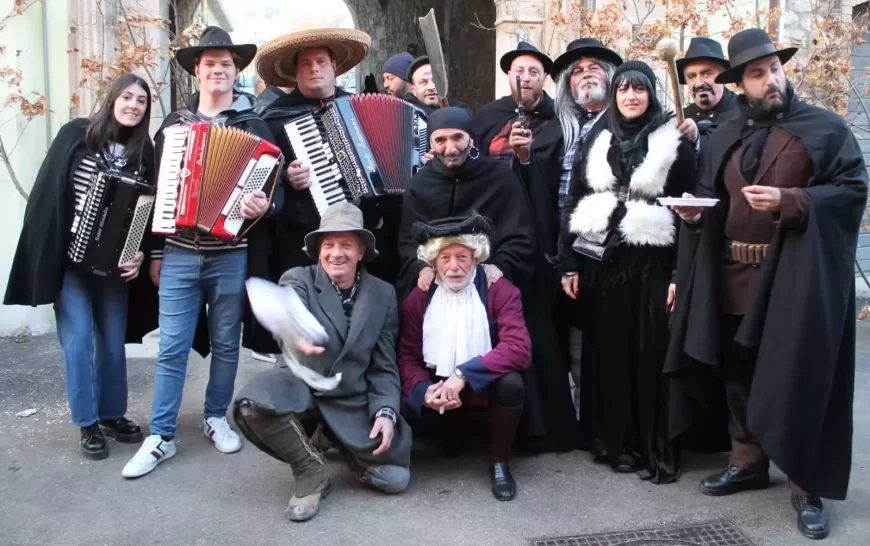
The Twelve Months of the Year and the Masquerade of Campolieto
Among the ancient carnival traditions of Molise, one of the most fascinating and unique is undoubtedly the “Mascherata dei dodici mesi dell’anno” held in Campolieto.
This small town in the province of Campobasso celebrates, during the Carnival period, a performance that blends popular culture, singing, and theatricality, rooted in a peasant tradition related to the personification of the months of the year.
The Mascherata: a story passed down through generations
The “Mascherata” of Campolieto likely originated as an expression of the village’s agricultural life. It consists of a choral representation featuring thirteen characters: the twelve months of the year and the Year, who guides them like a father proud of his children.
The performance is accompanied by sung verses in both dialect and Italian, with melodies supported by the sound of the accordion, a musical instrument deeply rooted in the traditions of Molise.
The original author of this composition is unknown, but it is known that the lyrics, preserved in a manuscript, were passed down from generation to generation.
With each edition of the masquerade, the protagonists change, with participants enriching their lines with personal elements, reflecting their level of education and life experiences.
The role of the months
Each month of the year is portrayed by a masked character, whose attire and role symbolize the characteristics of the respective month.
For instance, January appears fully hooded, holding a stick, symbolizing the cold and the hardships of winter. With his stick, he shakes the snow from the shepherds’ haystacks, intending to “blind” them for speaking ill of his month.
The cycle of nature and agricultural work is clearly reflected in the performance. The months take turns, singing their own verses, describing the weather, agricultural activities, and the challenges each period brings.
The Whole Year: the father of the twelve
The last character to enter the scene is the Whole Year, a noble and dignified figure representing the entire set of months. It is he who closes the performance with a verse in Italian, repeatedly emphasizing his role as a protective, symbolic father to the twelve months:
“I am a father and I am a lily,
and I am the father of twelve children.”
This passage is significant because it encapsulates the entire life cycle depicted by the masquerade: the year as a figure that embraces and guides the months, each with its individuality, but all part of a unified whole. 
The Briganti Skit
One of the unique features of the masquerade is the skit that follows the performance of the months. Ten actors perform a short play titled “I Briganti”, a moment that adds a touch of drama and entertainment to the celebration.
This part of the festival, while rooted in tradition, has a more popular and playful character, with a carefree tone that balances the solemnity of the months’ masquerade.
The performance in the square and the ritual of sharing
The performance of the Twelve Months does not take place in a theater or dedicated hall, but directly on the streets and squares of Campolieto. Sometimes even in front of the residents’ homes who request the performance.
After the performance, it is customary for the hosts to offer sweets and wine to the participants as a gesture of hospitality and gratitude.
This moment of sharing is one of the most characteristic aspects of the festival, strengthening community bonds and celebrating the abundance and conviviality typical of Carnival.
A living tradition among the young and old
The Mascherata dei Dodici Mesi involves people of all ages: from the young to the elderly, everyone participates by wearing traditional costumes drawn from the original manuscript. The festive atmosphere, coupled with the sense of historical continuity, makes this event a precious occasion to rediscover and value local traditions.
The Mascherata dei Dodici Mesi dell’Anno of Campolieto is a cultural heritage that represents much more than just a Carnival celebration.
It is a collective ritual that celebrates the bond between humans and nature, between the past and the present, with strong symbolic and community value.
The combination of singing, theater, and tradition makes this event unique. Preserving the historical memory of a small Molise village and showing how popular culture can still be alive and relevant in the contemporary context.
A festival, then, that, in addition to reviving history, creates a space for meeting and sharing. Tradition becomes the thread that unites different generations.
Photo Credits: Pro Loco Campolieto
