

Castelpetroso, a village suspended between history and faith
In the medieval period, the ancient village of Castelpetroso was dominated by a Norman-style castle built by the Lombards.
Today, only a few rooms of the ancient fortress remain, retaining the square shape of what once must have been the keep.
The structure now houses the “Museum of Peasant Civilizations” and an interesting artistic nativity scene in the 16th-century style. The characters wear the traditional costumes of the Pentri villages, while the buildings and landscapes are typical of the Molise region.
The original core of the historic center, now inhabited by only a few residents, still maintains the appearance it had back then.
The narrow stone alleys lead to the main square, where the beautiful Church of San Martino stands out. This building features a well-preserved 14th-century portal.
From the castle’s viewpoint, you can enjoy a spectacular panorama stretching 360 degrees across mountains and valleys.
The Sanctuary and the Apparitions of the Virgin
However, what Castelpetroso is best known for outside of Molise is certainly the Basilica of Our Lady of Sorrows, with the story of the apparitions that led to its creation.
It all began on March 22, 1888, when the peasant women Serafina and Viviana – also known as Bibiana – left the pasture to follow a sheep that had gotten lost.
Attracted by a glow in a cave, Bibiana had a vision of the Madonna kneeling before the body of the dark Christ, with her gaze toward the sky, arms open, and heart pierced by seven swords.
On Easter Sunday, the apparition repeated itself, and this time Serafina also saw the Virgin.
Word spread, and pilgrims began to arrive, prompting Bishop Francesco Macarone Palmieri of Bojano to launch an investigation.
In September, during an inspection requested by Pope Leo XIII, Monsignor Palmieri also witnessed the appearance of the Madonna.
Later, a spring formed next to the cave. The water that flowed from it cured the son of Carlo Acquaderni, the director of the Marian magazine Il Servo di Maria, from bone tuberculosis, which was incurable at the time.
A Basilica that Looks Like an Enchanted Castle
The miraculous healing of the son prompted Acquaderni, together with Bishop Palmieri, to start a fundraising campaign for the construction of a Sanctuary.
The first stone was laid on September 28, 1890. The project was entrusted to the Bolognese architect Gualandi, one of the leading figures of the Italian Neo-Gothic style.
It was in this style that the basilica was built, with the exteriors made of local stone by the Chiocco brothers of Oratino and the Pasquini brothers from Pietrasanta.
On the three portals, there are three mosaics depicting the Annunciation, the Crucifixion of Christ, and the Coronation of Mary and Jesus. These works were executed by the Bracci company of Pietrasanta.
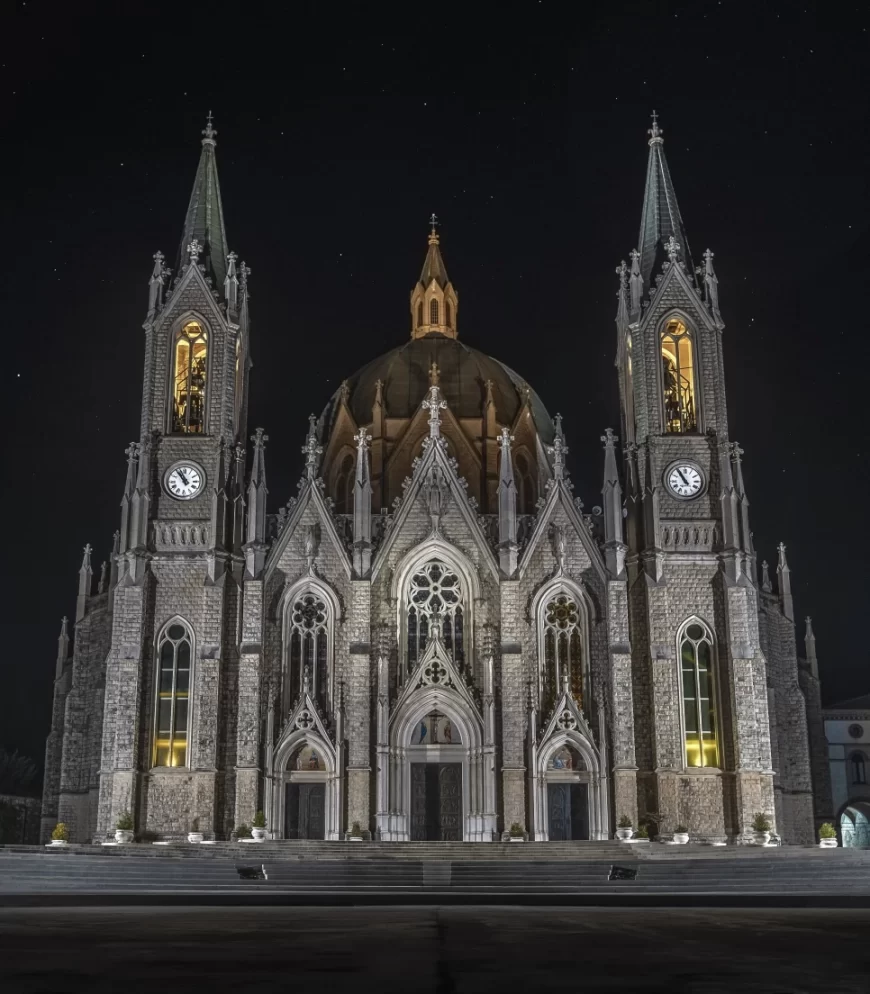
The layout of the sanctuary is radial, with chapels arranged to symbolize a heart pierced by seven swords.
The ceiling of the central dome, 56 meters high, is decorated with mosaics depicting the saints most venerated in Molise, the prophets, and the evangelists.
But what most strikes visitors about the Sanctuary is undoubtedly its magnificent façade. The rich, slender spires, the bell towers, and the dome rising above the marble carvings: if it’s winter and there’s snow, the view becomes unforgettable.
Hike on Monte Patalecchia to Discover the Via Matris
The minor Basilica of Our Lady of Sorrows was built further downstream from the site of the apparitions. The original cave no longer exists, but a stele has been placed in its place.
Not far away are the fountain from which the miraculous spring water flows and a small stone chapel.
To reach this point, you can enjoy a pleasant hike through the forests of Monte Patalecchia.
This is the Via Matris, a 750-meter path – open to the public in 1947 – that leads from the Basilica to the stele of the apparitions.
Along the way, there are niches containing copper shrines depicting the seven sorrows experienced by the Virgin Mary.
Beside the shrines are beautiful bronze sculptures created in the 1990s by artist Alessandro Caetani.
An Intimate Path of Faith
The Via Matris is designed to guide the pilgrim toward the sacred place where the Madonna appeared, with a heart renewed in faith.
The seven stages represent the “Presentation of Jesus in the Temple”, the “Flight into Egypt”, the “Loss of Jesus”, the “Meeting between Mary and Jesus on the Way to Calvary”, the “Crucifixion of Christ”, the “Deposition of the Dead Christ into the Arms of Mary”, and the “Deposition of the Dead Christ in the Tomb”.
In addition to these representations, there is a reproduction of the scene of the apparition as reported by Bibiana and Serafina. The bronze work was created by Urbano Buratti in 1975, depicting the Virgin, and by Alex Kostner in 2002, depicting the visionaries and the little sheep.
Similarly, at the edge of the parking lot, the archangels Gabriel and Michael are positioned. Their role is to prepare the faithful for an intimate moment of prayer.
Photo credits: Tommaso Labella
