

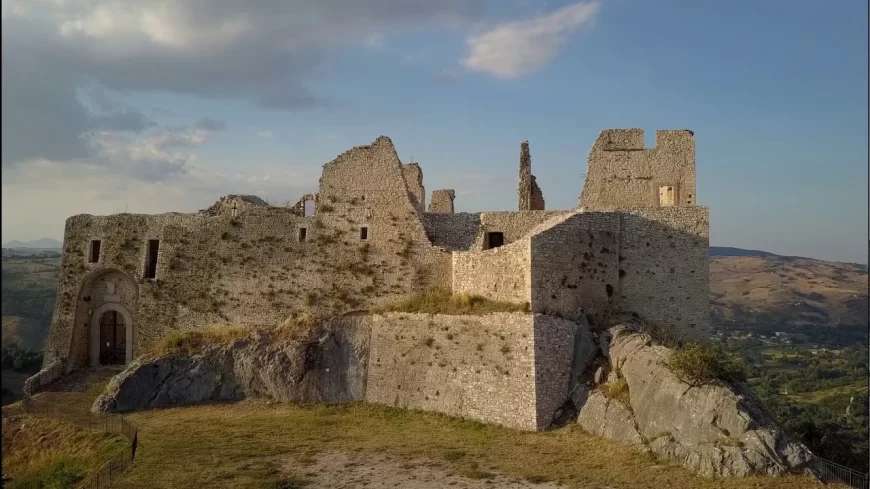
Exploring Castropignano
Castropignano is a small gem in the province of Campobasso. It is believed to have been founded in the distant Bronze Age (around 1200 BC) and that, thanks to its Castle and the noble family who once inhabited it, it was once a symbolic place for the practice of transhumance.
The village still enchants anyone who admires it from afar as it rises on a rocky formation overlooking the Biferno valley.
A cultural site to discover
Welcoming you is the enchanting Castello d’Evoli, which has been watching over every visitor or citizen who passes under its walls for centuries.
The building stands on an ancient Samnite fortification, and some research conducted on the site of the Castle has uncovered ceramics dating back to the Bronze Age.
Built around the mid-1300s, possibly on an earlier Lombard structure, it was thanks to the d’Evoli family that the building, originally a simple administrative and military outpost on the Castel di Sangro-Lucera route, became a noble residence at the beginning of the 17th century.
The family reorganized the entire layout, allowing the servants to have a floor to themselves and promoting fortification works around the entire building, including a defensive wall and a small tower on the southern side.
An ancient legend gives us an insight into the image once held of this extraordinary building.
It is said that the Castle had as many as 365 bedrooms inside, and that the owners liked to change rooms every night.
Although it’s likely that this story is a product of fantasy, it gives us a glimpse of the opulence and grandeur that once reigned in Castropignano.
The tragic story of the Fairy
Another legend is tied to the Molise village and especially to Castello d’Evoli, a story that, however, has no happy ending.
During the feudal era, a young woman so beautiful that she earned the title of Fairy lived in Castropignano and was promised to a young man from the village.
At the time, however, the Ius primae noctis law prevailed, the inhumane rule that stated that, in the case of a subject’s marriage, the first wedding night belonged to the feudal lord.
The poor girl, desperate and opposed to this law, was taken to the Castle, and once inside, she tried with all her might to resist and flee until her despair led her to throw herself into the abyss from a rocky spur that overlooked the void, now called the Cantone della Fata.
Photo Credits – Riccardo Zappalà
