

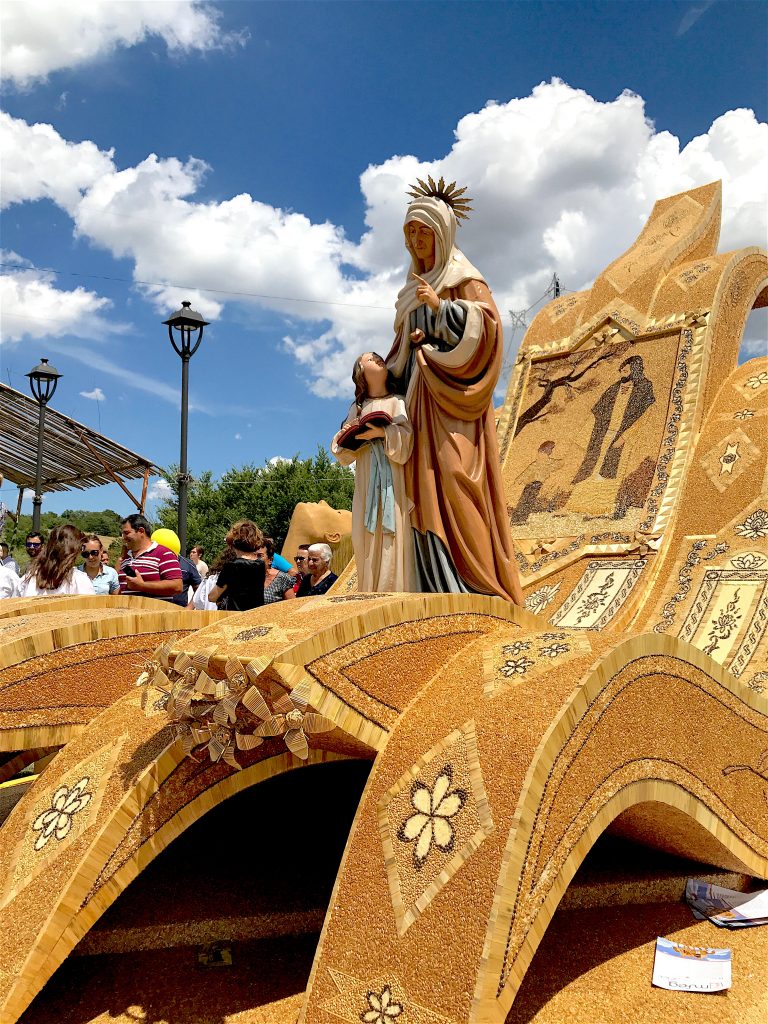
Treasures of Jelsi: Wonders of Gold and Wheat
Just a step away from Riccia and 30 minutes from the regional capital Campobasso, Jelsi is a vibrant village that brings the Fortore Valley to life with numerous festivals and events.
It is an authentic town of artisans and farmers, rooted in tradition yet youthful and innovative in spirit. This vitality is thanks to local associations and the Jelsi communities abroad, who continue to support and celebrate the town’s heritage.
Jelsi offers a warm and welcoming community, with countless opportunities to spend enjoyable moments.
The Wheat Town
Known as “the wheat town”, Jelsi is famous for its festival honoring Saint Anne on July 26. This event is tied to a unique tradition.
During the festival, numerous floats parade through the town’s streets, adorned with skillfully arranged grains and straw.
In recent years, the town—where once only traditional sledges (traglie) carrying sheaves of wheat were paraded—now hosts a dazzling golden carnival every July 26.
The Museo di Comunità della Festa del Grano (MUFEG) allows visitors to see some of these wheat artworks and learn about the origins of this centuries-old celebration.
The museum is housed in the beautiful Convent of Santa Maria delle Grazie.
In addition to the Saint Anne Festival, Jelsi hosts numerous food festivals, including the Funnateglie Festival (dedicated to a traditional Jelsi dish) and the Corn Festival.
Beauty and the Beast
The most famous of Jelsi’s traditions is U’ ball dell’Urz—the Bear Dance.
This performance, featuring a carnival mask, was celebrated until World War II, after which the tradition was abandoned due to the devastating conflict.
The bear mask, used exclusively during Carnival, is now displayed in the Chapel of the Santissima Annunziata.
This small chapel, located in the historic center, officially dates back to 1363, as indicated by the Gothic characters on the keystone of the portal.
The chapel, deconsecrated for centuries, held a secret that was only revealed in 1947.
During that year, Domenico Petruccioli, who managed performances in the chapel (then transformed into a small theater), decided to create a prompter’s box in the presbytery, which was used as a stage.
The Frescoes of the Annunziata Crypt
As with the discovery of the frescoes in Nero’s Domus Aurea on the Oppian Hill in Rome in the late 15th century, workers unexpectedly uncovered a vaulted underground chamber during construction.
This small space, half-filled with soil, was magnificently frescoed.
The Annunziata Crypt, accessible today via its original stone staircase, is a small vaulted room (6×5.5 meters) divided into two sections by a semicircular arch.
The walls feature depictions of saints and scenes from the life of Jesus, clearly inspired by Giotto.
Scholars note similarities between these frescoes and the famous Scrovegni Chapel frescoes in Padua, painted by Giotto and his collaborators between 1303 and 1305.
Among these invaluable frescoes is a rare iconographic element: the nudity of an adult Jesus, one of only four examples in Italy.
Jelsi is a place full of surprises and an unmissable destination during a visit to the Fortore Valley!
Instagram e Shopping Tips
Instagram tips:
- A selfie with the bear-man mask is a must.
- Capture artisans at work in the many countryside workshops.
- The wheat artworks in MUFEG are one-of-a-kind.
Shopping tips:
- Cianciullo Biscuit Factory: A historic bakery with regional and national sales of Molise specialties.
- Masseria San Paolo Farm: A multifunctional farm with an on-site store and educational activities for children and families.
- Jelsapore: Specializes in truffle-based products.
- Le Campagnole: Produces and sells fresh eggs from free-range chickens.
Where to Stay and Eat in Jelsi
Where to Stay:
- B&B Antichi Sapori: Owned by the same family that runs the renowned Roxy Bar.
Where to Eat and Drink:
- Villaggio Turistico Ciocca: Features a playground for children and a pizzeria.
- Bar Andare Oltre: A quirky and retro microbar.
