

A Trip to Carpinone, Between Hidden Waterfalls and Ancient Railways
In the heart of the province of Isernia, there are many areas where nature manifests itself in all its untouched beauty.
Forests, countryside, rivers, lakes, mountains: in this corner of Molise, there’s truly everything. Among the many villages that benefit from the strength of the landscape, Carpinone is definitely one of them.
The small town is easily reached in just a few minutes by car from Isernia. The route winds along a series of switchbacks that, curve after curve, reveal scenic views of the surrounding area, leading to the final view of the charming town.
The village, built by the Lombards in the 700s, sits on a rocky hill, within a double set of walls. The architectural layout of the buildings follows the fortification, with houses arranged in a semicircle.
Characteristic cobblestone alleys and houses covered in stone slabs are distinctive features. The train station, which houses the town hall, is also very beautiful.
The Caldora Castle
The Caldora Castle, with three of its five towers still intact and the perfectly preserved battlement walkway, is undoubtedly one of the most important features of the medieval town.
Its imposing profile is the first thing you notice when approaching the village.
The structure has withstood the passage of time, although it has undergone substantial changes compared to its original architecture.
However, the renovations over the years have not diminished its charm.
The castle, built in the 11th century and destroyed in 1223 by the order of Frederick II of Sweden, was rebuilt in the 14th century and became the residence of the Caldora Counts a century later.
During the renovations, some elements, such as the drawbridge, disappeared. The main facade still retains the gallery and the entrance door to the inner courtyard.
The Waterfalls: A Secret Hidden Just Steps from the Town Center
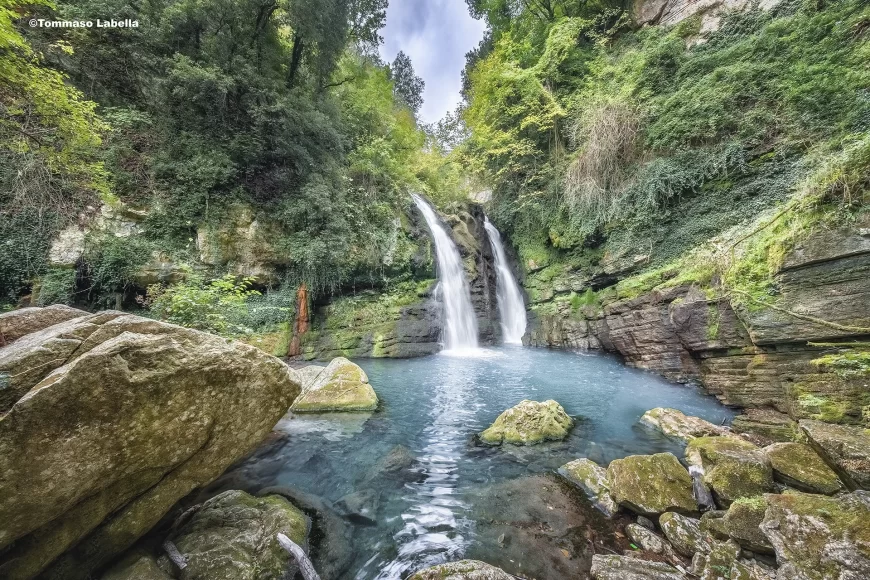
In just a few minutes, you can reach the waterfalls of Carpinone, which have gained fame recently thanks to their popularity on social media.
Images of the two streams of water flowing from the river into the pool below continue to go viral on the internet.
However, this fame is a very recent development. The interesting thing is that, until a few years ago, the waterfalls were practically unknown, even to many Molise residents.
The credit for bringing them into the spotlight goes to the association ‘Molise in Action’: a group of locals who created and published a photo shoot of the waterfalls online. They also worked on improving the accessibility of the site.
The response was immediate: the photos quickly gained views, and influencer Selvaggia Lucarelli even visited to take a selfie, which she posted on her Instagram profile. This was the final confirmation that turned the natural site into a well-known destination.
But the credit is all due to the undeniable beauty of the place. Surrounded by lush vegetation, the two waterfalls, formed by the meeting of the Carpino and Tuma rivers (one natural, the other artificial, created to power a hydroelectric plant), stand out in all their grandeur.
Their fame is undoubtedly well-deserved, and they are definitely worth a visit at least once.
Journey Through History: A Train Ride on the Transiberiana d’Italia
For history and nature lovers, a stay in Carpinone is also a must for another reason.
From this small town in the province of Isernia, you can experience the thrill of a time-traveling journey aboard a historic train.
We’re talking about the Transiberiana d’Italia, a railway line that connects Sulmona to Isernia, named for its route through the peaks of Molise and Abruzzo.
Along its 129 kilometers, stations such as Pettorano sul Gizio, Campo di Giove, Rivisondoli, Palena, Roccaraso, Scontrone, Castel di Sangro, San Pietro Avellana, Vastogirardi, Carovilli, and Carpinone are passed through.
Riding this train means immersing yourself in an almost enchanted mountain landscape, but it also means experiencing the emotion of traveling on vintage wagons dating back to the 1920s and 1930s.
Photo credits: Tommaso Labella and Abruzzoweb.it
