

Campobasso, the unexpected city
You might think that one day is enough to explore a small town with just under 50,000 inhabitants.
However, Campobasso is one of those places that speaks volumes to non-tourists, to those travelers who are not just interested in monuments and large museums.
Campobasso whispers to the ears of those willing to listen to new and different stories.
And there are many of them, scattered throughout the city, told through small details that many overlook.
It would take at least three days to fully explore the city.
But if you only have one day, no worries. Here’s what to do and see in just one day.
Inside the city walls
The history of Campobasso dates back to ancient times.
Its origins can be traced to a pre-Roman settlement along the tratturo.
Later, it became enriched with a fortress.
It was brought back to its former beauty by Nicola II Monforte, a fearless 15th-century leader.
He reshaped the entire hill and surrounding houses, surrounding them with a fortification still standing today.
A wall circuit with towers and gates that still magically isolates the medieval center of the city.
But now, let’s start exploring the city’s treasures.
From Castello Monforte to the Museo Sannitico
At the top of the hill stands Castello Monforte. It offers a spectacular view of the city and the surrounding plain.
Going down, you’ll encounter the Romanesque churches of San Giorgio and San Bartolomeo.
These lead to the old neighborhoods and the noble Renaissance palaces.
Among these, Palazzo Mazzarotta stands out: it hosts the Museo Sannitico.
Equally interesting is Palazzo Pistilli, which houses a remarkable collection of artwork.
The museums are incredibly rich, especially the Museo Sannitico.
It tells the grand story of the Sannites, thanks to thousands of artifacts from across the region.
Arriving at Largo San Leonardo – where the church of the same name stands – you’ll pass by the statue of Fred Bongusto.
Next, you’ll proceed to the Teatro Savoia and the Cattedrale, connecting the medieval district with the Renaissance commercial areas.
From the dispute between the Crusaders and the Trinitarians to the Processione dei Misteri
Right here, during the Middle Ages, in the area of markets and workshops, the dispute between the Crusaders and Trinitarians began.
The former were part of the Congregation of the Church of Santa Maria della Croce, ancient families within the walls.
The latter belonged to the newly formed Church of the Trinity (later the Cathedral), new commercial elites in the city.
The tragic love story of Fonzo and Delicata, from the two factions, foreshadowed the peace that would come only in 1587, during Lent.
Since then, the two congregations have worked together to develop the city and gave new life, together, to the Processione dei Misteri.
It is the most important event that fills the city streets every year, for centuries, during Corpus Domini.
The charm of the Ingegni del Di Zinno and the Museo dei Misteri
During the procession, all attention is on the Ingegni, created by Campobasso artist Paolo Saverio di Zinno.
Housed in the Museo dei Misteri, they were commissioned in the 18th century specifically for this unique figurative procession that showcases the popular soul of the city.
The ancient soul that honors the traditional procession by literally stepping into the roles of saints and demons, angels and devils to depict 13 sacred scenes, carried on the shoulders of organized teams of bearers.
The visual impact is unique. It generates awe and admiration among the many visitors who come to Campobasso to witness this procession live.
A stroll down the Corso and the murals of the San Giovanni district
Finally, to wrap up your day in Campobasso, a stroll along the Corso and Via Mazzini, the ancient tratturo path, is a must.
Before saying your final goodbye to the city, make sure to take a walk through the San Giovanni district.
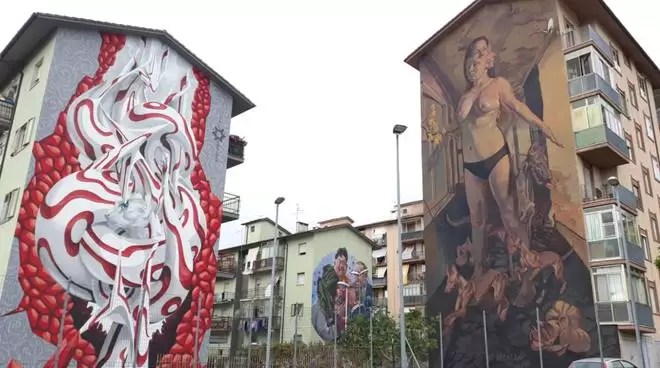
It is one of the many popular areas of the capital, enriched by huge and beautiful murals.
These murals were created by the world’s most famous street artists, as part of the now decade-long and world-renowned Draw the Line festival.
Photo credits: Primopianomolise.it and Primonumero.it
